
An aluminium moka pot like the classic Bialetti Moka Express will happily last decades. What usually shortens its life is not daily brewing but well-meant cleaning: a run through the dishwasher, a scrub with a green scourer, or a squirt of washing-up liquid every morning. Aluminium is soft and reactive, so it needs a gentler routine than your stainless pans.
This guide covers the everyday rinse, the occasional deep clean, how to deal with limescale in hard-water areas of the UK, and the parts that quietly wear out. None of it needs special kit.
Why aluminium needs different treatment
Bare aluminium reacts with strong alkalis and harsh detergents. Dishwasher tablets in particular are aggressive enough to leave the outside dull, grey and chalky, and that finish does not polish back. Abrasive pads scratch the soft metal and give coffee oils and scale more places to cling.
Inside the pot, a thin brown film builds up over time. Many moka pot owners deliberately leave a light layer of it, because a freshly scrubbed bare pot can make the first few brews taste slightly metallic. The aim is a clean pot with no rancid oil, not a mirror finish.
| Do | Avoid |
|---|---|
| Rinse in warm water once the pot has cooled | The dishwasher, even once |
| Use a soft sponge or cloth | Steel wool, green scourers, cream cleaners |
| Dry every part fully before reassembling | Storing it screwed together while still damp |
| Descale occasionally with a mild acid | Bleach, oven cleaner or soda crystals |
The everyday clean (two minutes)
- Let it cool. Unscrewing a hot pot is how people burn their hands and strip the threads. Run the base under cold water if you are in a hurry.
- Knock out the puck. Tap the funnel basket into the food bin or compost. Do not wash grounds down the sink.
- Rinse all three parts in warm water. Base, funnel and upper chamber. Wipe the inside of the upper chamber with a soft sponge to lift loose oil.
- Check the filter plate. Hold the top chamber up to the light. If the small holes in the metal filter look blocked, rinse from the inside out or nudge them clear with a soft brush.
- Dry and store apart. Towel everything dry and leave it unscrewed, or loosely assembled, so the gasket is not squashed and no water sits trapped in the base.
That is all most days need. Plain water is what Bialetti recommends for routine washing, and it is enough to stop coffee oils going stale.
Is a drop of washing-up liquid really that bad?
A tiny amount occasionally will not destroy the pot, especially if it has gone sticky after a week at the back of the cupboard. The problem is making it a habit: detergent strips the coffee film each time and can leave a soapy taint in the next brew if you do not rinse thoroughly. If you do use it, keep it to the upper chamber and funnel, rinse twice, and run a water-only brew before your next real cup.
The monthly deep clean
Every few weeks, or whenever the coffee tastes flat or slightly rancid, give the pot a proper going-over.
- Remove the gasket and filter plate. On a Moka Express they pull out of the upper chamber; ease the gasket out with a blunt butter knife rather than anything sharp. Wash both, and clean the groove behind them, which is where old coffee hides.
- Lift stubborn stains with bicarbonate of soda. Mix a little with water into a paste and work it gently with a soft cloth. Rinse well. This is mild enough for aluminium if you do not scrub hard or leave it sitting.
- Clean the spout and column. A bottle brush or pipe cleaner reaches up inside the central column of the upper chamber.
- Check the safety valve. Look at the little valve on the side of the base. Gently press the pin if it has one to make sure it moves freely. A valve crusted with scale is a genuine safety issue.
Descaling in UK hard-water areas
Much of southern and eastern England has hard water, and you will see it as a white crust inside the base and around the valve. Scale insulates the base, so brews take longer and can taste cooked. If you live in a hard-water area, our guide to hard water and home espresso in the UK covers the wider picture.
To descale an aluminium moka pot:
- Fill the base to just below the valve with a mix of roughly one part white vinegar to two parts water, or a teaspoon of citric acid dissolved in water.
- Fit the empty funnel (no coffee) and the upper chamber, and heat it on the hob as if brewing.
- Discard the liquid once it has come through, then repeat with plain water two or three times until there is no vinegar smell.
Keep acid contact short. Leaving vinegar to soak overnight can pit and discolour aluminium, which is the opposite of what you want. Every one to three months is plenty for most households; filtered water for brewing stretches that further.
Parts that wear out (and are cheap to replace)
| Part | Signs it needs attention | What to do |
|---|---|---|
| Rubber gasket | Hard, cracked or flattened; coffee or steam leaking at the join | Replace with one sized for your pot (cup size matters) |
| Filter plate | Bent, holes blocked even after cleaning | Usually sold together with the gasket |
| Funnel basket | Dented, or grounds escaping into the base | Replace if it no longer sits flat |
| Safety valve | Stuck, heavily scaled, or hissing on every brew | Descale; if it stays stuck, retire the base |
If you are tightening the pot harder and harder to stop leaks, the gasket is almost certainly due. Replacing it costs far less than a new pot and makes an old one brew like new.
Already ruined the finish?
If your pot has been through the dishwasher and come out grey and chalky, it is usually still safe to use once you have rinsed off any loose residue and run a couple of water-only brews. It just will not look the same. If the inside is pitted, the threads are stripped, or the valve no longer moves, it is time for a replacement.
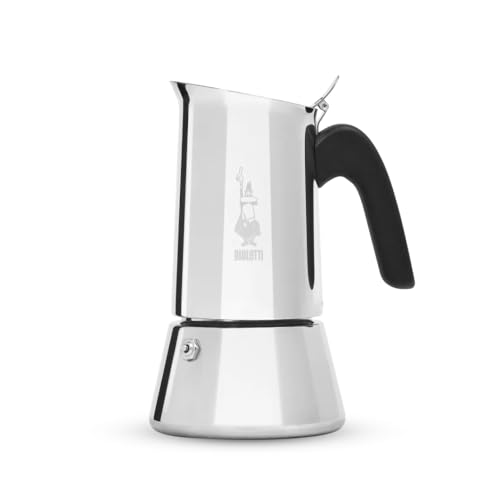
If you want something you can be rougher with, stainless steel moka pots tolerate more vigorous cleaning and also work on induction hobs. We compare the two styles in Bialetti Moka Express vs Venus.
Quick checklist
- Cool, empty, rinse in warm water, dry, store apart: every brew.
- No dishwasher, no scourers, no harsh cleaners on aluminium.
- Pull the gasket and filter plate every few weeks and clean behind them.
- Descale with diluted vinegar or citric acid every one to three months in hard-water areas, then rinse with two or three water-only brews.
- Replace the gasket when it hardens or leaks; check the safety valve moves freely.
Look after the gasket and keep the dishwasher well away, and an aluminium moka pot will keep making strong, honest coffee for years.