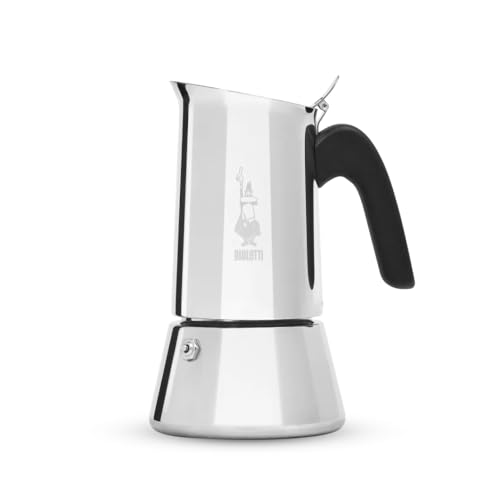
Induction hobs are brilliant for pasta water and terrible at forgiving moka pot habits. Put a moka pot on the boost setting and within a couple of minutes it is spitting, hissing and pushing out a harsh, burnt-tasting brew. The coffee is not the problem. The heat is arriving too fast and too hard.
This guide covers why that happens, how to make sure your pot actually works on induction, and a simple routine that gets a smooth, steady flow instead of a volcano. It applies to any induction-ready moka pot, such as the stainless steel Bialetti Venus Induction.
Why induction makes moka coffee bitter
A moka pot works by heating water in the base until steam pressure pushes it up through the coffee. On gas, the flame warms the base gradually. Induction heats the metal of the pot directly, and on higher settings it does so very quickly. That leads to three common problems:
- Water gets too hot before it moves. Very hot water pulls harsh, bitter compounds out of the grounds.
- Flow surges. Pressure builds fast, so the coffee rushes through in a spluttering burst rather than a slow, honey-like stream.
- The end goes on too long. By the time it starts gurgling, the last of the water is steam-blasting through spent grounds, which adds a burnt, ashy note.
Some hobs also cycle power on and off at low settings. You may see the flow stop and start. That is the hob pulsing, not a fault with the pot.
First, check your pot will work at all
Induction only heats magnetic metal. A quick test: if a fridge magnet sticks firmly to the base, the pot should work.
| Pot type | Works on induction? | Notes |
|---|---|---|
| Aluminium (for example the classic Moka Express) | No, not on its own | Needs an induction adapter plate, which heats more slowly and less evenly |
| Stainless steel with a magnetic base (for example the Venus Induction) | Yes | Best option if induction is your main hob |
| Aluminium top with a steel base insert | Usually | Check the base is labelled induction-compatible |
Size matters too. Many induction zones will not detect a pan below a minimum diameter, and small 1- to 3-cup pots often fall under it. If the hob flashes or refuses to start, try the smallest zone, or use a slightly larger pot. If you are still choosing a pot, our comparison of Bialetti Moka Express vs Venus covers which suits which hob.
The induction routine that stops the spitting
- Start with hot water in the base. Fill the base with just-boiled water from the kettle, up to just below the safety valve. This shortens the time the coffee sits on heat and is the single biggest fix for bitterness. Hold the hot base with a tea towel when you screw the pot together.
- Fill the basket level, do not tamp. Grind a little coarser than espresso, roughly like fine table salt. Fill the basket to the brim, level it with a finger and brush loose grounds off the rim so the seal is clean. Pressing the coffee down makes the flow sputter.
- Use a medium setting, never boost. On a 1 to 9 scale, start around 5 or 6. You want the coffee to appear after a minute or two, not in seconds.
- Turn it down when coffee appears. As soon as the first coffee comes through the spout, drop to a low setting or 2 to 3. The pot holds enough heat to keep a gentle flow.
- Stop early. When the stream turns pale and starts to hiss or gurgle, take the pot off the hob straight away. Run the base under the cold tap for a few seconds to stop the brew. That last pale bit is where most of the bitterness comes from.
Leave the lid open while it brews so you can watch the flow. A steady, slightly foamy stream is what you are aiming for.
Troubleshooting by taste and sound
| What you notice | Likely cause | Try this |
|---|---|---|
| Violent spitting, coffee sprays out of the spout | Heat setting too high | Drop a setting or two and turn down as soon as coffee appears |
| Bitter, burnt or ashy taste | Water too hot for too long, or brew ran to the end | Pre-heat water in the kettle; pull it off at the first gurgle |
| Sour, thin and watery | Grind too coarse or heat too low | Grind a touch finer; raise the setting by one |
| Flow stops and starts | Hob pulsing on a low power level | Use a medium setting on a smaller zone instead of the lowest level |
| Hob will not detect the pot | Base not magnetic or too small for the zone | Magnet test; try the smallest zone or an adapter plate |
| Steam or coffee leaking from the join | Grounds on the rim or worn gasket | Brush the rim clean; replace the gasket if it is hard or flattened |
Grind makes more difference than you think
Pre-ground supermarket espresso is often too fine for a moka pot, and fine grounds slow the flow, raise pressure and push the brew towards bitterness. A grind like fine table salt usually works better. If you grind at home, a decent hand grinder lets you make small changes until the flow and taste are right.

Change one thing at a time. If you adjust grind, heat and dose all at once, you will not know which one fixed it.
Keep the pot itself in good shape
A blocked filter plate or a stiff gasket makes any pot sputter, whatever the hob. Rinse it after every brew and pull the gasket out every few weeks to clean behind it. In hard-water areas, scale in the base also slows heating and can make flow uneven. Our guide on how to clean an aluminium moka pot covers the routine, and most of it applies to stainless steel pots too.
Quick checklist
- Magnet sticks to the base, and the pot is big enough for the zone.
- Just-boiled water in the base, up to just below the valve.
- Basket filled level, not tamped, rim brushed clean.
- Medium heat to start, turn down as soon as coffee appears.
- Off the hob at the first gurgle, base under the cold tap.
Get those five right and an induction hob becomes one of the easiest ways to make a moka pot behave: once you know your setting, it is the same every morning.